
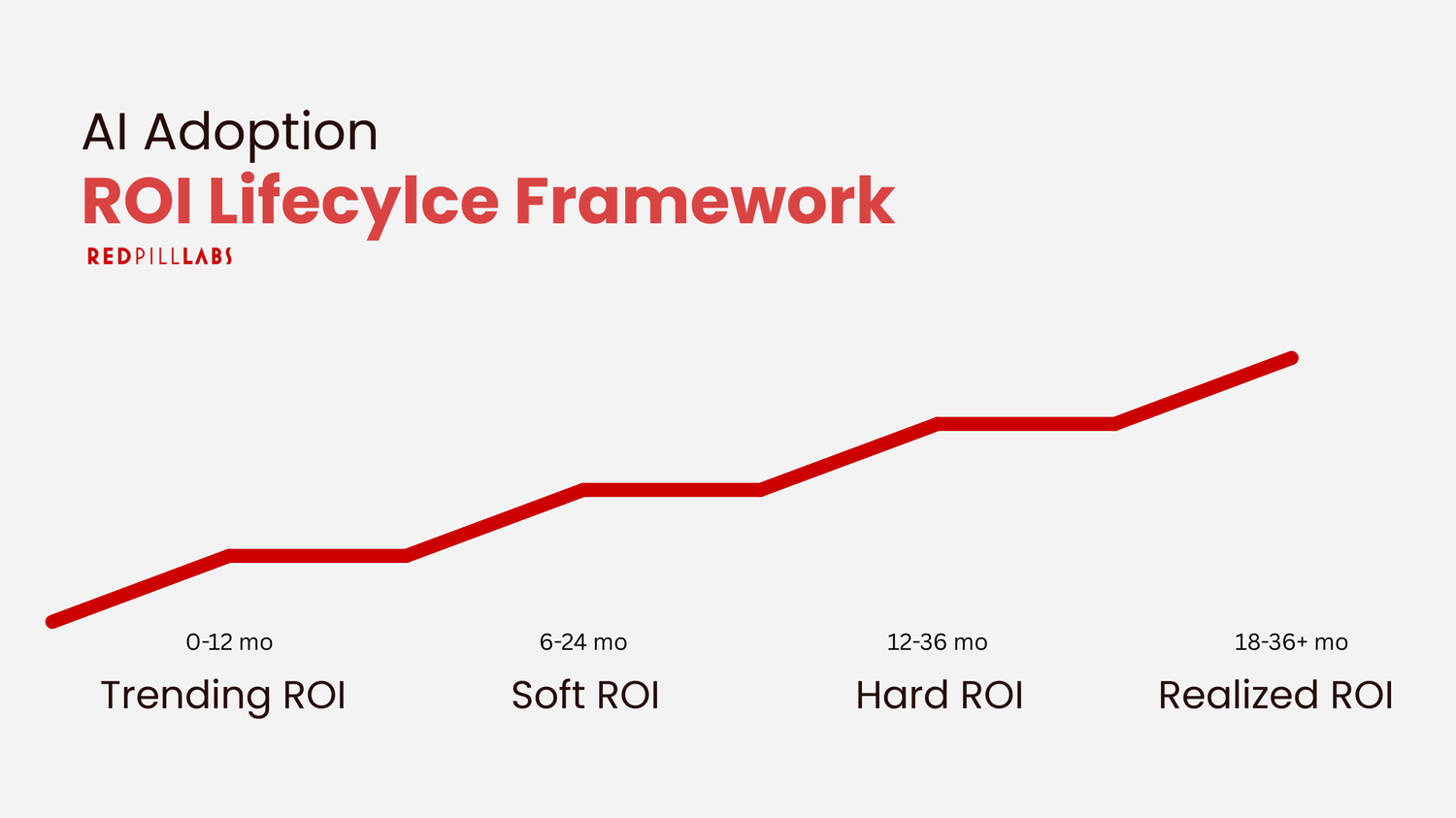
The phrase “AI First” has become the modern manifesto: using artificial intelligence everywhere in the company. However, for most entrepreneurs, the first step was never technology—it was return.
Successful companies have always operated under a guiding question before innovation:
Does this make more money, reduce costs, or accelerate measurable outcomes?
If the answer is no, the project is an expense, not an investment.
The Problem with Mindless “AI First Adoption”
Many companies are betting on AI without strategy:
- AI projects with no business goals
- Chatbots with no users
- Automation that doesn’t improve margins or sales
- Expensive pilots that never scale
- AI applied where there is no real business problem
This is driven by a seductive narrative that sounds great on stage but avoids the question that truly matters:
What is the economic model behind this AI?
Artificial intelligence is transformational, but only when it removes a real bottleneck to ROI, not when it becomes digital wallpaper.
ROI First Adoption: The Sustainable Path
Companies capturing real ROI from AI follow a disciplined pattern:
- Identify a critical business problem
(Operational inefficiency, low conversion, sales leakage, high process costs, poor retention, etc.) - Quantify the cost of that problem
How much money are we losing today by not solving it? - Define the KPI to move
Time, cost, tickets, conversion, churn, repeat purchases, margins, etc. - Design the simplest solution that produces ROI
Use AI only if it is the best method to move that KPI. - Implement, measure, improve fast
- Scale what works
AI First Adoption When It Actually Makes Sense
“AI First” becomes the right approach only after validating:
✔ AI solves a problem tied directly to ROI
✔ The return can be measured and attributed
✔ It scales without operational chaos
The One Equation That Always Wins
AI is not valuable for being new. AI is valuable for being profitable.
The real adoption maturity model is:
ROI First → AI Smart → AI Validated → AI Scaled → AI First with purpose
Not all problems need AI, but all AI projects need ROI models.
The Final Question
The question that separates real innovation from a tech trend is:
Does this AI produce or protect return, or just look impressive in a slide deck?
If you can’t answer that with data, you’re not adopting AI—you’re adopting costs.